

Birth Time Precision
Refine an Approximate Birth Time with Life Events
VamAstro helps you investigate uncertain birth times using dated life milestones and transparent chart evidence — not guesswork.

A more precise time. A clearer you.
Why Is It So Difficult to Know Your Exact Birth Time?
If you know you were born “around 3:30 PM” but not the exact minute, you are not alone. For many people, the birth time recorded in a certificate, remembered by family members, or written down years ago may be approximate.
But there is another question that is often overlooked:
What exactly do we mean by the “moment of birth”?
During childbirth, several moments can occur within a short period — delivery of the baby’s head, complete delivery, the first cry or breath, umbilical cord clamping or cutting, and the recording of the birth time. These moments are not necessarily identical.
Add rounded hospital times, family memories, conflicting records, births close to midnight, and historical time-zone considerations, and determining an exact birth time can become surprisingly complicated.
In Vedic astrology, this matters because birth time establishes the Lagna (Ascendant), houses, and other time-sensitive components of the birth chart.
Birth Time Precision helps you investigate this uncertainty using significant events from your life rather than simply guessing a minute.
The Exact Moment of Birth
A birth may appear to have a single timestamp, but the real-world process can involve several different moments — often within the same few minutes.
There is no single universally accepted definition across all astrological traditions that makes one physical event the definitive astrological birth moment. For VamAstro, the practical approach is to start with the best available recorded or remembered birth time and investigate uncertainty when that time is approximate.
The goal isn’t to find a single “perfect” second, but to find the time that best fits your life. — VamAstro
Which moment is the “birth time”?
During childbirth, several moments can occur. These can be a few minutes apart. Depending on the circumstances, you may hear different timestamps for the same birth:

Head delivered
Full body

First cry

Cord clamped
Time recorded
- — Baby’s head delivered
- — Full body delivered
- — First cry
- — Cord clamped
- — Doctor recorded birth time
These moments are not necessarily identical, and may happen within minutes of each other.
Common Reasons Your Birth Time May Be Uncertain
There are many real-world reasons why the recorded or remembered birth time may not be exact.

Rounded time
A birth at 3:27 PM may have been recorded as 3:30 PM.

Family memory
A parent may remember “around 3:30” rather than an exact minute.

Conflicting records
Hospital, registration, and family notes may disagree.

Birth near midnight
11:59 PM and 12:01 AM are different calendar dates — two minutes apart.

Historical time zones
Older births need the zone rules for that place and date.

Different interpretations
Delivery, first breath, and recorded time are not always the same event.
This real-world uncertainty is why birth-time refinement is useful — and why guessing a random minute rarely holds up against your life timeline.
Why Birth Time Matters in Vedic Astrology
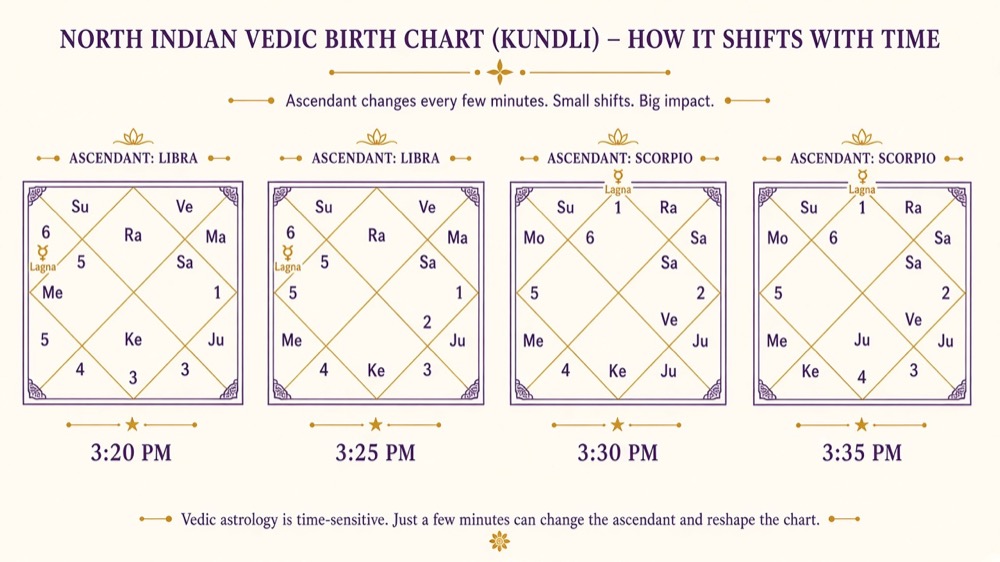
Birth time fixes the Lagna (Ascendant) and the entire house map. Even a 10–15 minute error can change the Lagna near sign boundaries, which ripples through house lords, yogas, dasha balance, and timing techniques.
- Dasha & antardasha depend on a stable Moon nakshatra and chart foundation.
- Divisional charts (D9, D10, etc.) are sensitive to Lagna and cusps.
- Kundli, matching, remedies, Oracle, and Today’s Guidance assume one consistent birth moment.
A Few Minutes Can Make a Difference
Illustrative Lagna shift — same date and place, times five minutes apart:
From Uncertainty to Evidence
Instead of debating which minute “feels right,” Birth Time Precision treats your life milestones as clues — marriage, children, career shifts, relocation, and more — and scores candidate birth times against them using multiple Jyotish techniques (BTP-1.2).
You keep your original estimate on record. Refinement adds a supported range, a representative center, and per-event evidence — honest uncertainty, not a fake exact second.

Life events become testable hypotheses for your chart — not folklore.
What is Birth Time Precision?
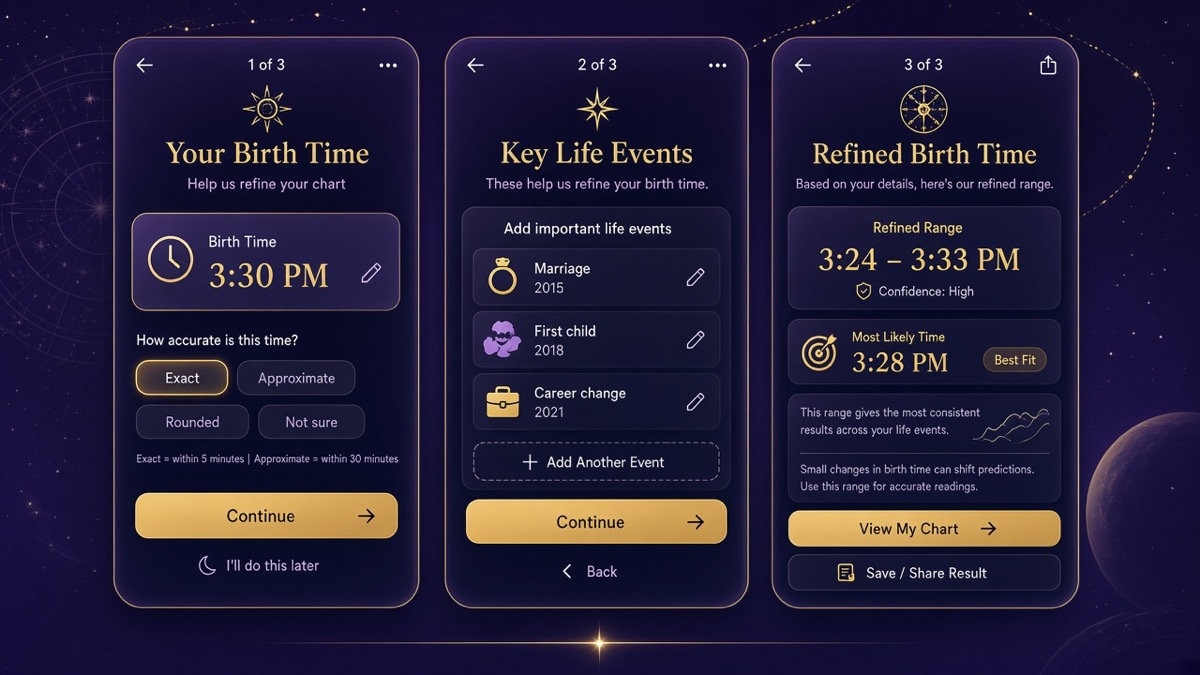
Birth Time Precision (BTP) is VamAstro’s birth-time rectification flow. Enter an approximate anchor, set how well you know it, adjust the search window, add dated milestones, and run analysis. The engine returns preserved estimate, supported range, representative center, and milestone evidence.
Nothing silently overwrites your profile until you choose Apply to profile after review.
How It Works — 3 Simple Steps
Same flow in the Flutter app and on the web.
Who should use it?
- Rough or approximate birth time — not a trusted certificate minute.
- At least a few dated life events (exact dates help most).
- One coherent birth moment for Kundli, matching, remedies, and Oracle.
Not a substitute for legal identity records. Review results before applying to your profile.
Life milestones that help
Marriage, first child, major career moves, business start, property, graduation, relocation — well-dated events tighten the supported range. Prefer exact calendar dates when you have them; include a mix of life domains when possible.
Understanding your results
- Your estimate (preserved) — anchor you entered.
- Supported range — e.g. 15:24–15:33.
- Representative center — best-fit time inside the range.
- Milestone evidence — technique-level notes per event.
Apply to profile (optional)
Updates your profile birth moment so horoscope, Kundli PDF, Today’s Guidance, Ask the Oracle, matching, and remedies recalculate. You confirm before apply.
Already have an exact time?
Enter certificate time in Profile. Full rectification targets approximate anchors; exact times can use sensitivity analysis to see how fragile the chart is if the clock were slightly wrong.
Tips for better refinement
- Set birth place from autocomplete for correct timezone.
- Use the suggested search range; widen only if needed.
- Add at least three strong milestones before expecting a tight range.
- Re-run when you remember additional dates.
Frequently Asked Questions
Is Birth Time Precision the same as a pandit’s rectification?
It follows classical rectification ideas — testing candidate times against life events — but automates multi-technique scoring (BTP-1.2) with transparent evidence in the app. You review before applying any change.
Will it overwrite my original birth time?
No. Your session preserves the anchor you entered. Profile updates only when you explicitly apply a refined time.
How many life events do I need?
One event can run, but three or more well-dated milestones usually produce a tighter supported range.
What if I was born near midnight?
Treat date and time as high-sensitivity. Confirm place and timezone first, then use a wider search window until evidence stabilizes.
Get started
- 1. Sign in to VamAstro.
- 2. Open Birth Time Precision from Home, Profile, or the tools grid.
- 3. Enter birth context, milestones, and review results.